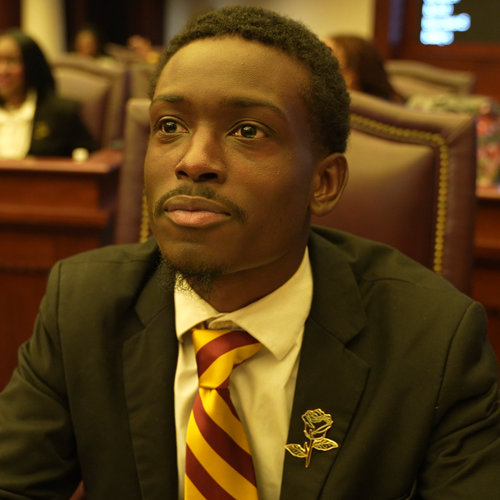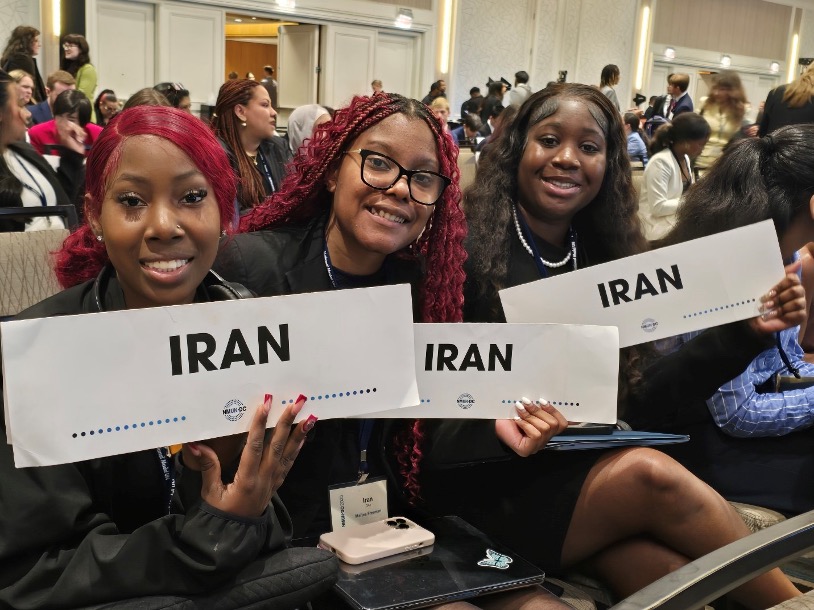
B-CU students Javin Francis, Ashia Senai Rolle and Maitae Freeman represented Iran at National Model United Nations in Washington, D.C. Credit/rights: Courtesy of Bethune-Cookman University; embedded in the internal trip report.
DAYTONA BEACH, Fla. — Three Bethune-Cookman University students stepped into the role of international diplomats in Washington, D.C., representing Iran during the 2025 National Model United Nations conference.
Javin Francis, a freshman pre-nursing major; Ashia Senai Rolle, a sophomore political science major; and Maitae Freeman, a graduating senior political science major attended the Nov. 7–9 conference with faculty advisers Edoh Agbehonou, Ph.D., and Tseleq Yusef, Ph.D.
The Wildcats prepared to argue from the perspective of an assigned nation rather than their personal views. That requirement pushed them to research Iran’s policy positions, understand the rules of multilateral negotiation and communicate with delegates whose objectives sometimes conflicted with their own.
Francis served on the Commission on Narcotic Drugs, Rolle worked in the General Assembly First Committee and Freeman participated in the General Assembly Third Committee. The committees addressed different subjects, but all demanded the same core skills: listening, coalition building, public speaking and precise writing.
According to B-CU’s conference report, delegates in the three committees negotiated six, nine and 10 resolutions, respectively. Each document required students to identify shared priorities, draft language and persuade other delegations to support a workable proposal.
“NMUN taught me that diplomacy is not about winning every argument,” Francis said in the University report. “It is about understanding what others need and finding the place where everyone can move forward.”
The official conference program shows how closely the simulation follows United Nations practice. Delegates met at the Washington Hilton for committee sessions, opening and closing ceremonies, rules briefings and speaker programs. Students also worked under conference expectations for professional conduct and collaborative debate.
For the B-CU delegation, the experience brought political science concepts into a setting where choices carried immediate consequences. A position had to be defended, an amendment could change the direction of a proposal and every relationship mattered when it was time to build support.
The conference also gave the three students a chance to learn from one another across academic levels. A first-year health sciences student, a sophomore political science student and a graduating senior each brought a different perspective to the delegation while sharing responsibility for B-CU’s representation.
Their work reflects the University’s commitment to developing globally aware leaders. Model United Nations asks students to research deeply, speak with confidence and search for common ground — skills that matter in government, health care, law, business and community service alike.
Preparation began before the delegation arrived in Washington. Students had to study the assigned country, committee topics and conference rules, then translate that research into position papers and negotiation strategies. Representing a nation with complex relationships required them to distinguish evidence from assumption and to anticipate how other delegations might respond.
Committee work rewarded patience as much as performance. Students moved between formal speeches and informal caucuses, where delegates tested ideas and assembled working groups. A proposal could advance only when participants listened closely enough to find language that multiple countries were willing to accept.
The experience also broadened the meaning of global education at B-CU. International learning does not happen only through travel abroad; it also develops when students analyze unfamiliar perspectives, work across differences and recognize how decisions made in one region affect people elsewhere.