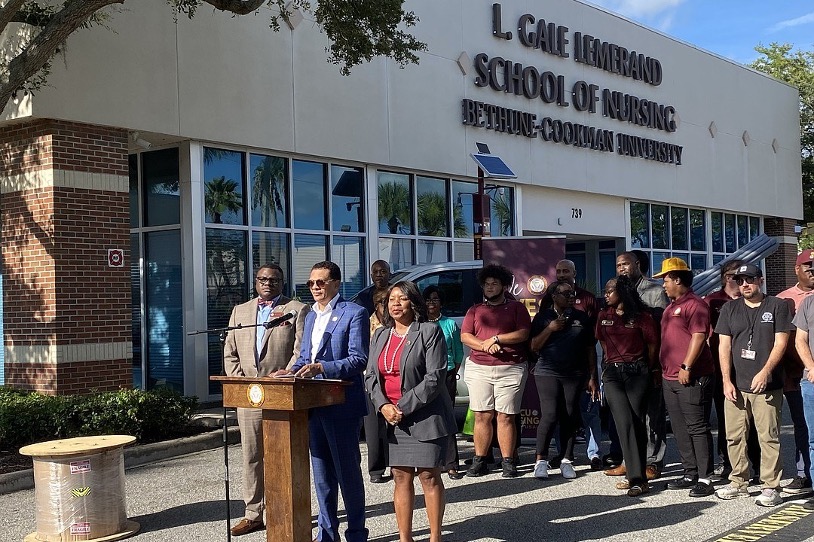
B-CU leaders and technology staff mark the launch of ForCORE outside the L. Gale Lemerand School of Nursing. Credit/rights: B-CU-supplied image published by Observer Local News; obtain the original high-resolution file and final photographer credit before publication.
DAYTONA BEACH, Fla. — Bethune-Cookman University has broken ground on a major upgrade to the digital infrastructure that supports teaching, research and campus operations.
University leaders, students and technology staff gathered July 1 outside the L. Gale Lemerand School of Nursing for the first dig of ForCORE, a three-year network modernization project supported by a National Science Foundation award of $897,563.
The first phase replaces aging fiber between the School of Nursing and Faith Hall with high-capacity connections. Work was scheduled to continue through July 22, establishing an early segment of the backbone that will ultimately improve speed, security and reliability across campus.
The infrastructure is largely invisible when it works well, but nearly every part of a modern university depends on it. Online learning, laboratory research, cloud applications, videoconferencing, financial systems, campus safety tools and everyday communication all move through the network.
ForCORE is designed to support a 10-gigabit-per-second backbone along with AI-assisted firewalls, improved network monitoring and stronger disaster-recovery capacity. Together, those improvements will help B-CU manage greater data demands and respond more effectively to cyber threats or service disruptions.
President Albert Mosley, Ed.D., described the first dig as an investment in student success and institutional capacity. Chief Information Officer J. Michael Williams, Ph.D., emphasized that the project will give the University a more dependable platform for research, instruction and future technology initiatives.
The NSF-funded work is especially important as B-CU expands research and workforce-focused programs. Students and faculty need stable access to high-performance tools, large datasets and collaborative platforms. A stronger network makes those activities possible while supporting the routine systems that keep the campus running.
The project also creates a visible link between physical construction and digital transformation. The fiber installed underground will carry the classes, experiments, conversations and services that connect people above it.
Local news organizations covering the ceremony highlighted both the scale of the grant and the University’s focus on resilience. The first dig marks the beginning, not the completion, of the work; additional phases will extend improvements and modernize how the system is protected and managed.
For students, the goal is simple: technology that is faster, safer and more dependable. For B-CU, ForCORE provides the foundation to compete for new research opportunities, deliver innovative instruction and prepare Wildcats for a world in which digital infrastructure is essential to nearly every profession.
Network resilience is especially important in Florida, where severe weather can interrupt power and communications. Improved monitoring and disaster-recovery planning can help technology teams identify problems faster, protect critical information and restore services with less disruption to teaching and campus operations.
Security is equally central. Universities manage academic, financial and personal information while supporting thousands of devices and users. Modern firewalls and clearer network visibility give staff better tools to recognize unusual activity without slowing the legitimate research and learning the system exists to support.
The project will require careful coordination as new infrastructure is installed around an active campus. Phased construction allows the University to modernize essential connections while managing outages, testing new equipment and communicating changes to the people who rely on the network every day.